How Nscale automated GPU fault diagnosis and remediation across the fleet.
Hardware faults are unavoidable at the frontier of computing. How much they cost is not.
Modern GPUs run at the very edge of what fabrication can achieve, and they run there 24 hours a day. Cables degrade. Optics lose signal. Components expand and contract through thousands of heat cycles. All of this is expected behavior from hardware being pushed as hard as it was designed to be pushed. What separates infrastructure providers is how quickly and reliably they respond when faults inevitably occur.
At Nscale, the answer lies in Fleet Operations, the automation and observability system that runs our GPU fleet, from the moment a node is racked to the day it's retired. We've written before about how Fleet Operations automates the GPU lifecycle and what that journey looks like for a single node. But operating at massive scale requires solutions built for it, including when those nodes start reporting errors.
Manual triage doesn't scale
Traditionally, diagnosing a faulty GPU node has been gated by the speed of a person walking to a rack. An engineer has to locate and pull the node, run a battery of tests, read the results, try a fix, test again, and either return the node to service or escalate. Each step depends on a person being available to run the process by hand. At the scale Nscale operates, with deployments measured in a build up toward several hundred thousand GPUs, and delivered on schedules measured in weeks, that model ceases to be effective no matter how much effort or headcount you throw at it.
At Nscale, we are building as an AI-native company in the same way that we build for our AI-native customers. So we engineered the process to be AI-native itself. Within Fleet Operations, our diagnostics and remediation layer treats hardware health as a workflow to be automated instead of a queue to be worked.
Diagnosis in seconds
With this intelligent operational layer, when a node fails validation or degrades in production, diagnosis begins in seconds. The system runs a comprehensive test sequence across compute, memory, networking, and storage, determining the most likely cause from existing documentation before an engineer has even read the first alert.
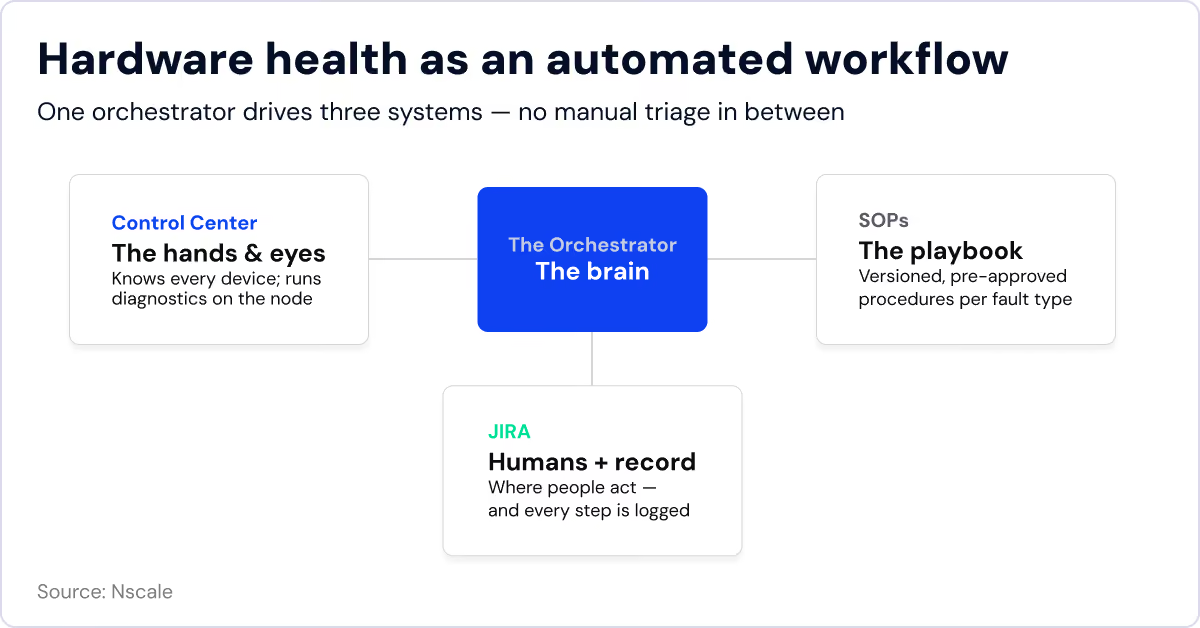
Many issues can be resolved without anyone touching the hardware at all. When a fix does require human intervention, such as a component being reseated or an optic swapped, the system raises a ticket with everything the technician needs already in it: which data hall, which rack, which slot, and exactly what to do on arrival. Our engineers walk into the data hall with a precise plan. As soon as the physical work is done, automated validation takes over again and the node can be returned to service, minimizing downtime.
Every repair is logged against the node's history, permanently. If a fault recurs, the system knows what was tried before and responds accordingly. As the fleet grows, so does its accumulated knowledge of how hardware fails and how to fix it. As Nscale grows, our accumulated expertise expands exponentially too, leading to a positive feedback loop where larger deployments give better information for what fix will likely lead to the quickest, most effective outcome.
One discipline, from racking to retirement
The rigor that keeps a live fleet healthy is the same rigor that validates new capacity in the first place. The burn-in and validation workflows that stress-test every node during data center turn-up, before a single customer workload runs, are built from the same foundations as the diagnostics that protect nodes in production. Enrollment, validation, remediation, and return-to-service form one continuous discipline across day-0 stand-up and day-2 operations. A node meets the same quality bar on the day it's commissioned as it does throughout its economic life.
That continuity is only possible because Nscale operates a fully vertically-integrated stack. We design the data centers, own the hardware, and run the software that manages it, making us as efficient as possible. Accountability never changes hands, and that is precisely what allows Nscale’s level of automation to reach all the way down to the rack, beyond others in the market.
The invisible hand of Fleet Operations
Our customers never see this system, and by design they never need to. What they see is the outcome: clusters that work on arrival, faults that are found before they become failures, and hardware that returns to service in hours rather than days. Higher availability, more predictable performance, and the confidence that comes with choosing the right AI cloud provider for demanding AI workloads.
Every model trained and every token served on Nscale infrastructure sits on top of thousands of automated decisions made every day in the background. Operating at the frontier demands a new level of automation, and we're building our fleet around it.
Interested in learning more? Talk to our team about how Fleet Operations keeps your capacity available.