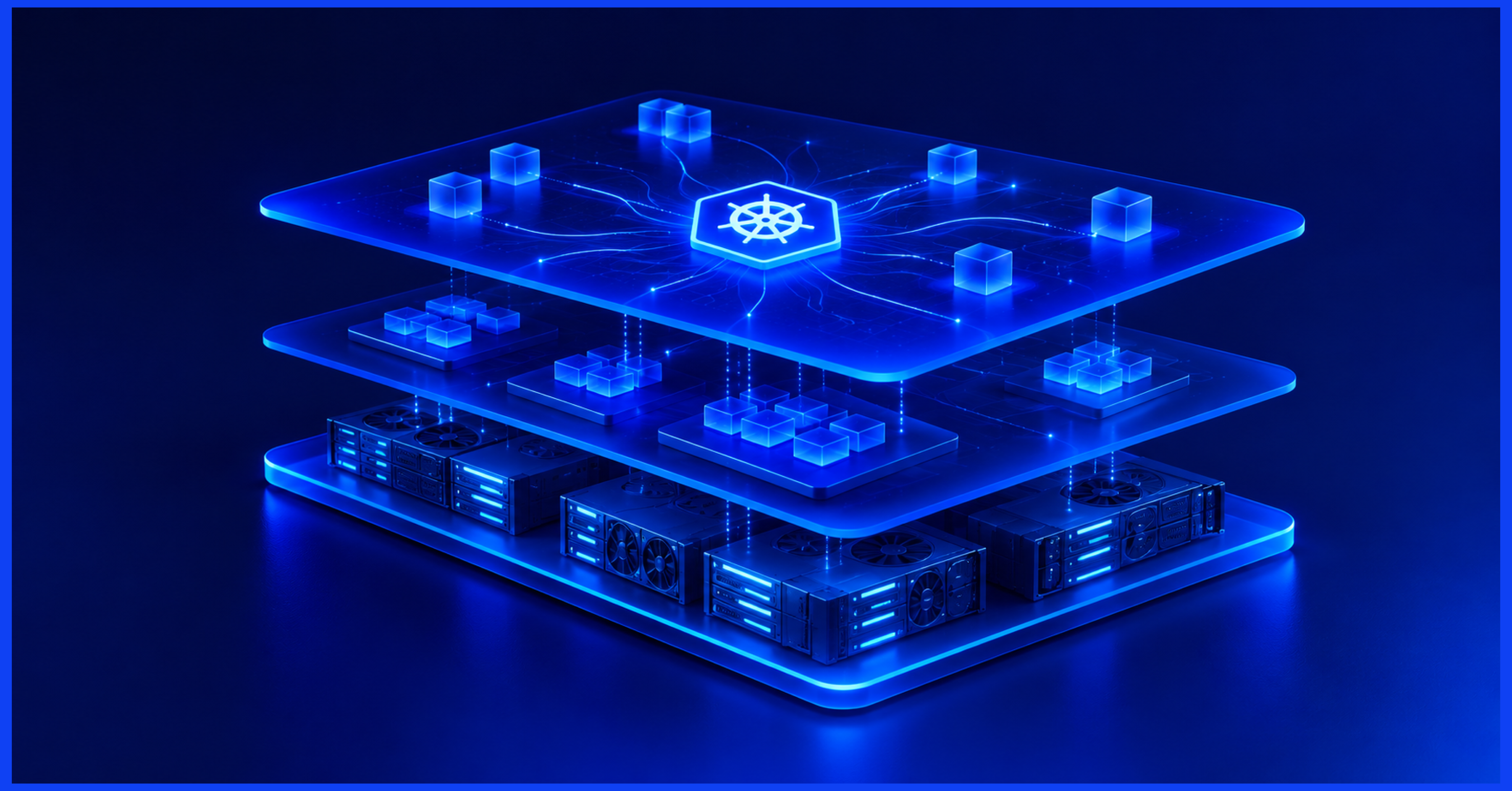
Kubernetes runs containerized workloads across a fleet of machines. Here's how that works for AI, and what managed Kubernetes handles for you.
Kubernetes, often shortened to K8s, is the industry-standard software for running containerized workloads across a fleet of machines. Teams specify the applications they need to run and the resources they require, while Kubernetes handles where those workloads run, balances demand across available infrastructure, and flexibly reacts when capacity or system health changes. This lets teams focus on the workload itself, while Kubernetes manages the underlying hardware behind the scenes to keep it running efficiently.
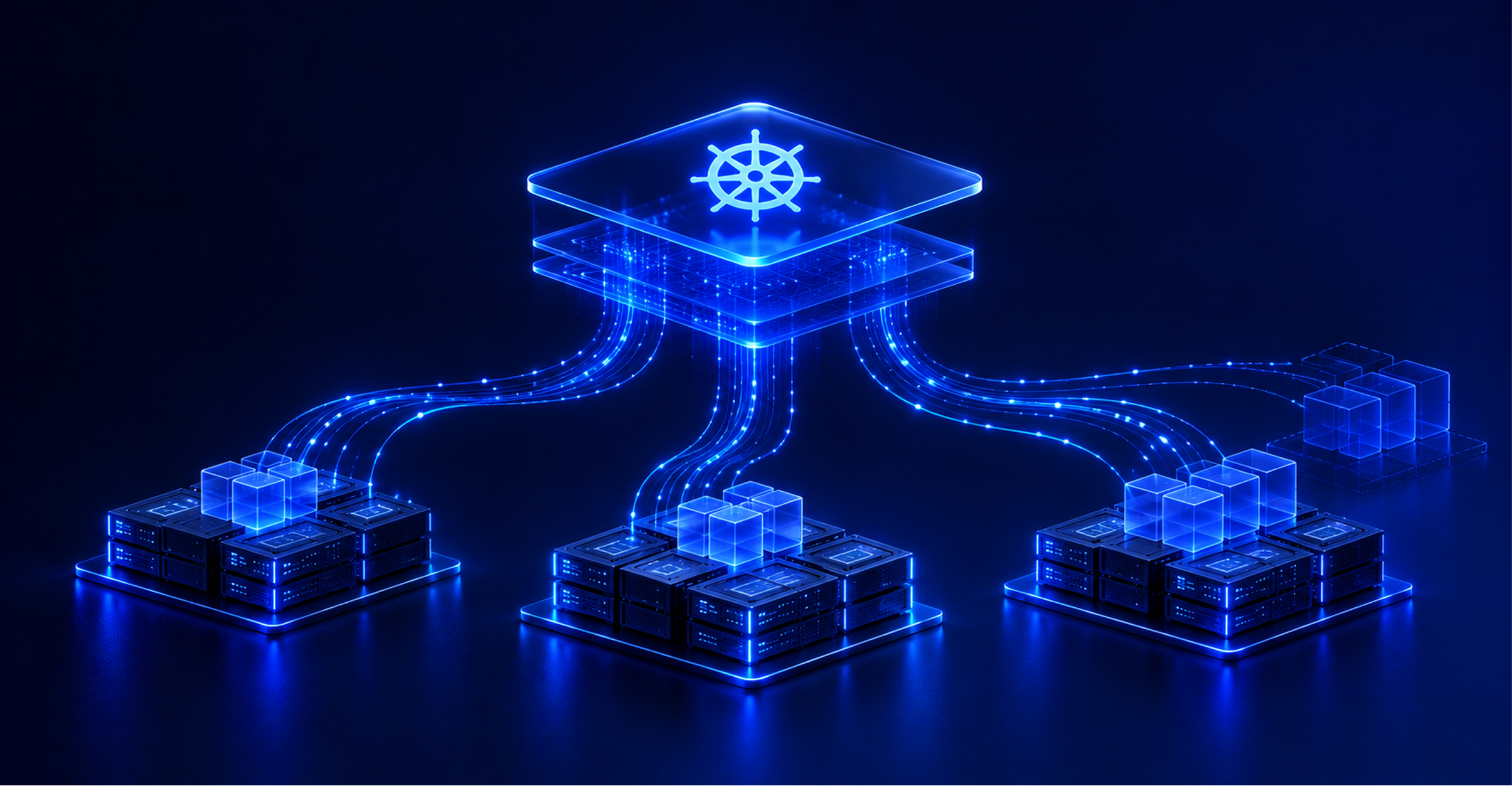
A Kubernetes deployment has two main parts: the control plane, which makes orchestration decisions, and the worker nodes, the machines that actually run the workloads.
If a machine goes offline, Kubernetes can reschedule its work elsewhere. If demand increases, it can add capacity to handle it.
Why use Kubernetes for AI workloads?
AI workloads make this orchestration particularly important. Training a model can span multiple GPUs, inference demand can change quickly, and teams may have many jobs competing for the same pool of accelerators.
GPU capacity is also at a premium, and where workloads are placed can affect performance. For workloads that need to run across multiple GPUs, placing those GPUs close together in the data center can reduce the latency of communication between them. Teams therefore need to keep clusters healthy, manage capacity, and place workloads efficiently.
Doing that while also operating Kubernetes takes specialist expertise and ongoing operational work. With managed Kubernetes, a provider runs, secures, upgrades, and monitors the control plane, while handling cluster health, node lifecycle management, and GPU scheduling. Teams can continue using standard Kubernetes APIs and tooling while focusing on their applications and models.
Self-managed vs. managed clusters
Managed Kubernetes reduces the operational burden of running a cluster. Here’s how it compares with a self-managed cluster.
.png)
Self-managed Kubernetes maximizes infrastructure control. Managed Kubernetes trades some of that control for significantly lower operational overhead.
What is Nscale Kubernetes Service?
Nscale Kubernetes Service (NKS) is a fully managed, AI-optimized Kubernetes offering built on Nscale's GPU infrastructure.
NKS supports Kubernetes across development and production workloads. Lightweight, isolated Kubernetes environments give teams a fast way to develop and test, with clusters provisioned in minutes. For production workloads, NKS provides hardened orchestration with integrated observability, networking, and cluster policies.
The service combines GPU-aware scheduling and intelligent GPU placement with autoscaling and built-in failure recovery, helping teams run AI workloads efficiently as their infrastructure requirements grow. That means Nscale customers can run mission-critical AI workloads in an optimised environment purpose-built for our platform, enhancing performance, reliability, and more efficient use of resources at scale.
What are the core capabilities of NKS?
Managed control plane: Nscale runs and secures the Kubernetes control plane, so customers focus on workloads rather than the orchestration layer underneath them.
GPU-aware scheduling: Workloads are placed on well-connected GPUs to minimize latency across training and inference jobs.
Autoscaling: Clusters scale up and down with demand, reducing the risk of idle capacity or bottlenecks.
Standard, upstream Kubernetes: NKS runs upstream Kubernetes with no vendor-specific lock-in mechanisms, unlike the downstream distributions common among hyperscalers.
Enterprise-grade multi-tenancy: Project scoping, RBAC, audit logging, and SSO integration (SAML and OIDC) support secure isolation between teams.
Room to scale: Teams can move from virtual clusters for experiments up to enterprise-grade super-clusters on the same platform.
What's the value for AI teams?
Performance optimization. Autoscaling and GPU-aware scheduling help avoid both bottlenecks and underused capacity.
Lower operational cost. Customers avoid the cost of hosting and staffing their own Kubernetes operations.
Sharper focus on workloads. Teams manage applications and models rather than nodes, networking, or the control plane.
.png)
What makes Nscale's approach different
NKS runs standard, upstream Kubernetes rather than a downstream distribution. Hyperscalers often customize Kubernetes with proprietary extensions that make it harder for customers to migrate between providers, and those extensions can carry hidden costs.
Running upstream Kubernetes keeps NKS customers portable and avoids that lock-in, while still giving them a production-ready, GPU-optimized orchestration environment.
Who is Nscale Kubernetes Service for?
Teams without dedicated infrastructure resources: Organizations that want to focus on their workloads rather than the layers underneath them.
Teams standardized on Kubernetes: Any organization already using industry-standard container orchestration.
AI Natives: Companies building AI-native products that need reliable, GPU-aware orchestration.
Enterprise AI and ML teams: Central platform or ML teams running production AI workloads across an organization.
How do people get started with NKS?
NKS works out of the box. Teams can follow the documentation and start running workloads directly, managing clusters through the API, the Nscale Console, the CLI, or Terraform, whichever fits an existing workflow.
For production deployments or enterprise-grade super-clusters, customers can talk to an expert.
Ready to run Kubernetes without the operational overhead?
Get started with Nscale Kubernetes Service or talk to an expert about deploying at scale.

.png)