
When the starting point is AI rather than general-purpose cloud, every layer of the stack changes, and so does the relationship with the customer building on top of it.
Recently, I asked one of our engineers how many lines of code he had manually written in the last six months. His answer: not one. Not because the work had slowed, but because it had accelerated beyond what traditional coding workflows could support. AI had taken over the authoring. He was focused on architecture, validation, and shipping faster than before.
That exchange points to something important about where enterprise AI is heading. Enterprise spending on generative AI grew from $11.5 billion in 2024 to $37 billion in 2025, a more than threefold increase in a single year. Token demand has risen 28 times since the end of 2024. The infrastructure underneath all of that is no longer a procurement decision; it is a strategic one.
The companies best positioned to compete in the AI era are not necessarily the largest. They are the ones built specifically for AI: no legacy constraints, no accumulated service debt from a pre-GPU era, and crucially, no separation between what they sell and how they operate.
At Nscale, those three properties, AI-native design, full-stack vertical ownership, and internal use of our own platform, are decisions we made from day one.
Why legacy cloud was never built for AI
Hyperscalers started with traditional cloud. That origin shapes everything that followed. Years of service layering and optimization for general-purpose workloads have produced platforms that are, by design, comprehensive rather than focused. The accumulated complexity has a measurable cost while specialized AI cloud providers can achieve two to three times lower charge for on-demand GPU rates than equivalent hyperscaler pricing. Cost is one signal; design intent is the deeper issue.
When infrastructure is built specifically for AI, every decision from the power supply through to the application layer is made with AI workloads as the design constraint. There is no legacy to carry, no catalog bloated by requirements from a time when the primary use case was web hosting or relational database storage. At Nscale, inference, fine-tuning, and training are not add-ons to a general cloud; they are the reason the platform exists. Because every layer is owned and operated by the same company, optimization is not confined to software: it extends to GPU kernel tuning, inference engine benchmarking, and the physical infrastructure sustaining those workloads at scale.
Built for AI means using AI
The engineer who had not written a line of code by hand in six months is not an outlier. It is what AI looks like in production when the right conditions are in place: teams trust the tooling, validation catches errors early, and using AI is encouraged rather than questioned. When those conditions exist, productivity doesn’t improve incrementally, it compounds.
But those gains depend on infrastructure. Platforms designed for general-purpose cloud struggle to support continuous model iteration, high-throughput inference, and agentic workflows at scale, which is where many enterprise efforts stall.
How we use our own platform internally sets the standard for what design partners and enterprise customers should expect. Partnerships with NVIDIA and VAST Data reinforce this further: both work directly with our engineering teams on benchmarking, performance standards, and co-development, stress-testing that standard from the outside in.
Rather than offering a fixed solution, we also work alongside enterprises through inference deployment, model fine-tuning, and secure AI implementation to learn and validate as adoption matures. The result is a relationship where customers are not downstream of a roadmap but building alongside it.
This is where AI-native cloud diverges from legacy cloud most clearly. Instead of delivering static infrastructure optimized for broad workloads, it evolves in step with how AI systems are actually built and used.
Inference at scale is a latency and location challenge
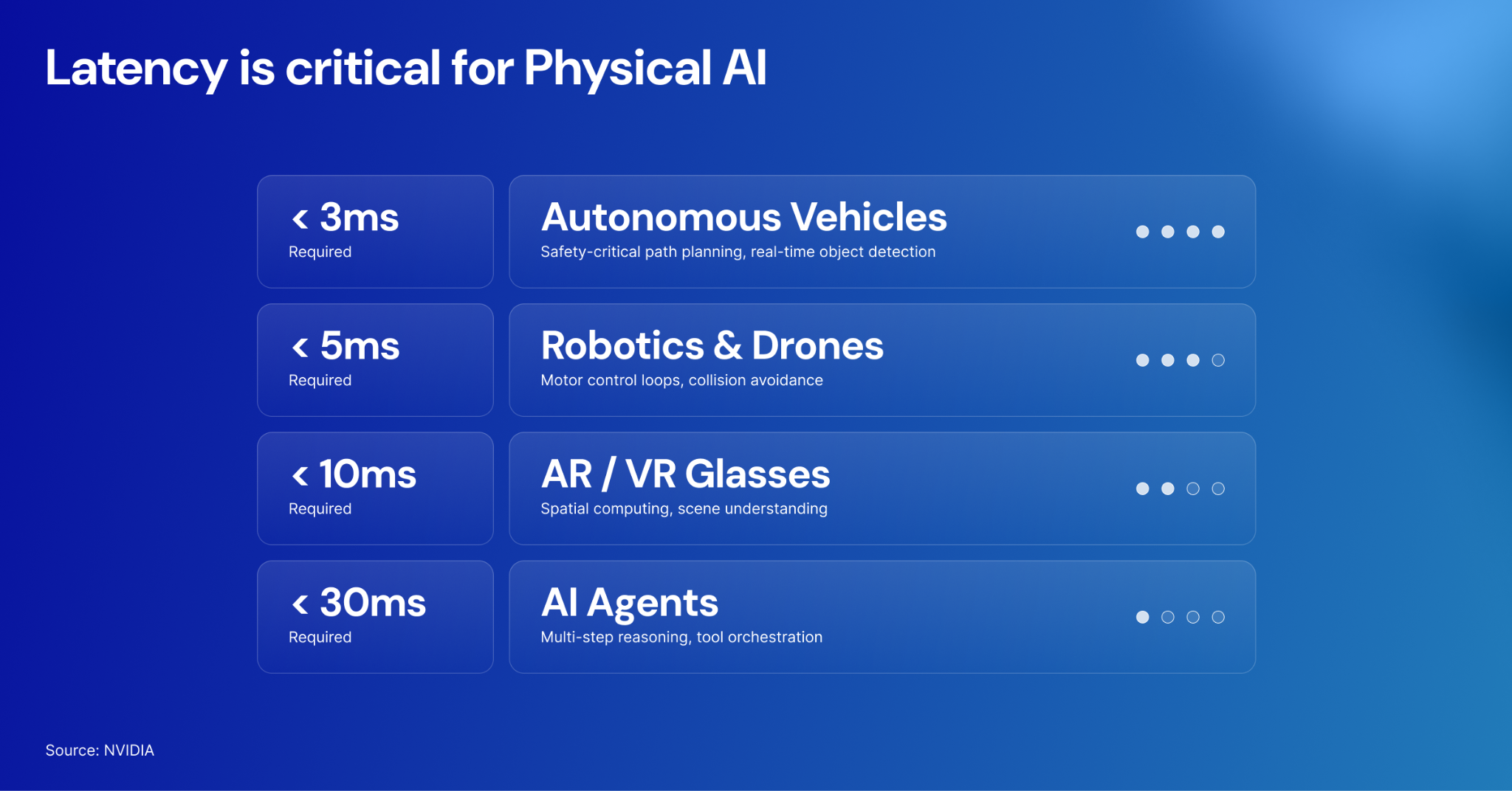
The shift from training-dominant to inference-dominant AI workloads is already underway. By 2030, inference is expected to surpass training and become the dominant AI workload, accounting for more than half of total AI compute, according to McKinsey. But unlike training, inference is latency-sensitive. According to NVIDIA, agentic AI workloads require response times below 30 milliseconds for multi-step reasoning and tool orchestration, while AR and voice applications demand sub-10 millisecond response times. At those thresholds, geography becomes a system constraint: the physical distance between compute and the end user directly determines whether a product works in production.
This is where legacy cloud models begin to break down. Centralized regions optimized for general-purpose workloads cannot consistently meet the latency requirements of distributed, real-time AI systems. Inference is not just a compute problem; it is a placement problem.
Nscale’s architecture is built around that reality. Large hub facilities handle compute-intensive training workloads, while distributed spoke deployments bring inference closer to where tokens are consumed. For more, read our AI Grid report.
Agentic AI doesn't wait for infrastructure to catch up
By the end of 2026, 40% of enterprise applications are expected to include task-specific AI agents, with nearly half of enterprises already deploying them in production. Organizations that have operationalized AI internally are reporting operating cost reductions of 20 to 40%, according to Deloitte.
The constraint is now execution at pace. Building and operating AI-native infrastructure creates an operational advantage. The teams running the platform are also using it in production, which accelerates learning, improves reliability, and closes the gap between design and reality.
The next phase of AI adoption will be defined by how quickly companies close the gap between building systems and using them in practice.


.png)
